
Shaki margins for retailers: wholesale cost vs shelf price in the EU and UK
Most afro and West-African stores in the UK sell frozen Shaki between GBP 4 and 8 per kg, with prime honeycomb pushing higher. Your margin sits in the gap between your landed wholesale cost per kg and that shelf price, after pack size, prep time and waste. Here is how to work it out for your own shop.
The two numbers that decide your Shaki margin
Margin on Shaki is not complicated. But plenty of store owners price by gut and lose money either way. Too high and your regular Nigerian and Ghanaian buyers walk to the shop two streets over. Too low and you are working for nothing. It comes down to two numbers.
First, your landed wholesale cost per kg. That is the case price divided by the kilos in the case, plus your share of freight and cold-chain handling. When you buy from us it arrives frozen at -18°C, delivered DAP. The price you agree is close to the price that lands in your freezer, with no surprise import or clearing bill bolted on afterward.
Second, the shelf price your local market will carry. In most UK afro stores that is GBP 4 to 8 per kg for standard frozen tripe, more for clean honeycomb sold as prime Shaki. Your gross margin is the shelf price minus the landed cost, divided by the shelf price. Sell at GBP 6 against a GBP 3.50 landed cost and you are running a touch over 40 percent gross, before prep and waste. Those two are where stores quietly lose the margin they thought they had.
The shaki price per kg wholesale you pay is only half the equation. What you do with it on your side of the counter is the other half.
Sourcing for your store or wholesale?
Request a quote or browse the full catalogue.
Reading the UK retail bands honestly
I will be straight with you. Nobody can hand you a fixed shelf price that holds across every city and every month. Tripe moves with the cattle market, with freight, and with how many containers landed that week. What I can give you is the band most stores work inside, so you can place your own shop on it.
The table below is a working frame, not a quote. Use it to check where you sit, then adjust for your rent, your footfall and your buyers.
| Product on shelf | Typical UK retail band | Who buys it |
|---|---|---|
| Standard frozen tripe, mixed cut | GBP 4 to 6 per kg | Everyday cooking, soups, large families |
| Clean honeycomb Shaki, cut | GBP 6 to 8 per kg | Buyers who want the prized reticulum |
| Premium honeycomb, well-trimmed | GBP 8 and up per kg | Occasion cooking, festival demand |
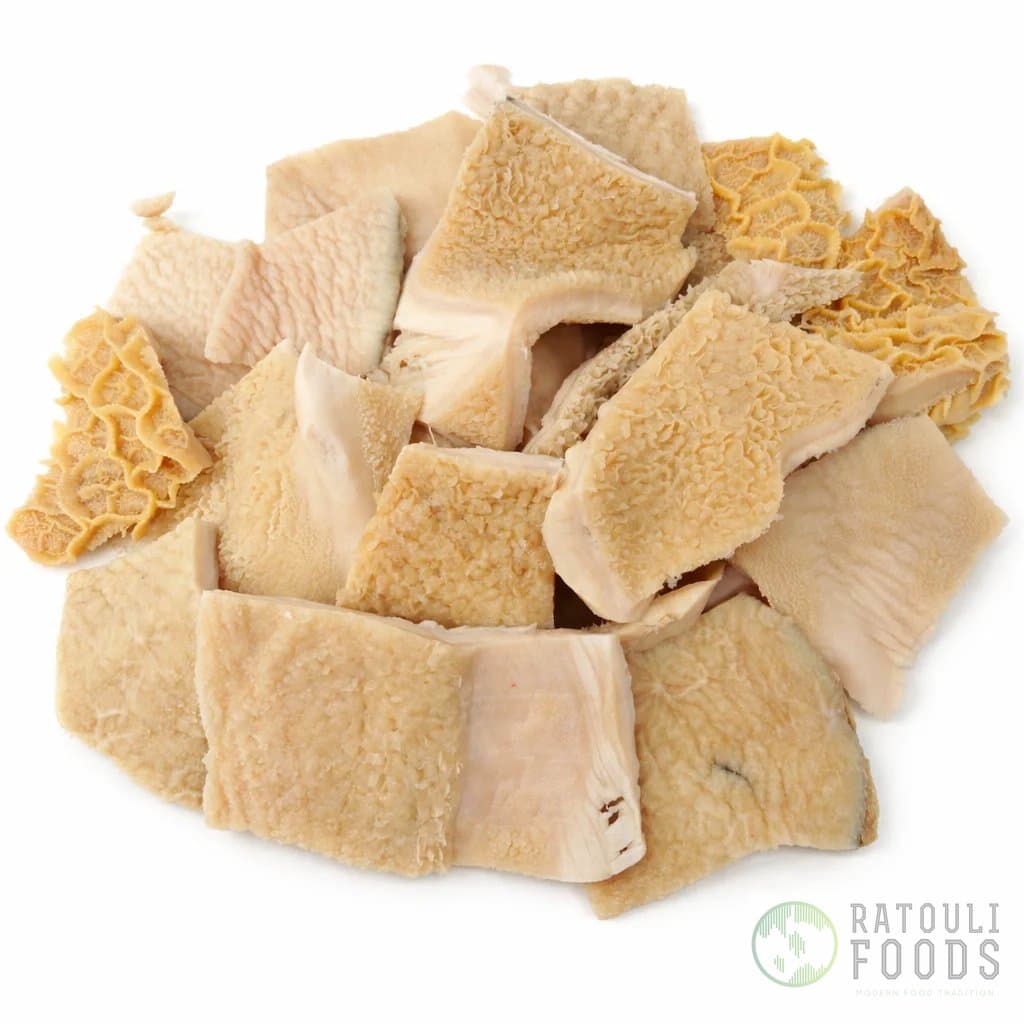
The premium does not come from a label. It comes from the cut. Honeycomb tripe, the reticulum, is the piece most buyers picture when they say Shaki, and a clean well-trimmed honeycomb earns the top of the band. The smooth blanket and the book tripe sit lower. If your supplier mixes everything together you cannot price up, because the buyer can see what they are getting.
One more honest point. A beef tripe retail margin looks healthy on paper, then shrinks the moment you start trimming, draining thaw water and binning offcuts in the shop. The band is real. Your kept margin depends on how clean the product arrives.
Pack-size economics: 12 x 1 kg versus 24 x 500 gram
Pack size is not a packaging detail. It changes how fast you turn stock and how much you throw away. We run Shaki in two cases, 12 x 1 kg and 24 x 500 gram, both scalded, cleaned, cut and frozen. They suit different shops.
- 12 x 1 kg works for stores with steady throughput and buyers who cook in volume for egusi, ogbono and big pots of pepper soup. Bigger units, fewer to handle, slightly lower cost per kg, and you move full kilos quickly so thaw-and-refreeze is rarely an issue.
- 24 x 500 gram works for higher-footfall shops and smaller households. The half-kilo unit is an easier price point on the shelf, you can sell a single pack without breaking a kilo, and you carry more individual sale units from the same freezer space.
The trap is over-buying the wrong unit. If a 1 kg pack thaws on your counter and only half sells, the rest is a refreeze risk and a quality complaint waiting to happen. A frozen tripe wholesale price that looks cheaper per kg on the big case is a false saving if you bin a portion of every pack. Match the unit to how your buyers actually shop, then price each unit to land inside the band above.
Run the numbers per sale unit, not per case. A 500 gram pack that retails at GBP 3.50 against a landed cost near GBP 1.90 holds the same margin logic as the kilo, but it sells faster and waits less in the freezer.
Why scalded-and-cut protects the margin you planned
This is the part most pricing math skips. The gap between a healthy margin on paper and the cash you keep is prep and waste in your shop. Raw, unbleached green tripe arrives cheaper, then costs you on the back end.
Cleaning tripe properly is real work. You scrub it down with rock salt and vinegar or lime, scrape inside the honeycomb folds, and par-boil before it is fit to sell or cook. Do that in-store and you are paying staff time, using water and gas, and losing weight to trim and drain-off. Every kilo you bought shrinks before it reaches a buyer.
Our Shaki lands scalded, cleaned and cut, dressed white rather than green. The hard prep is already done in an EU-approved plant under HACCP, NL208262EG, with a public NVWA inspection record. For your shop that means three concrete things:
- Less staff time at the back, because there is no scrubbing and scraping before sale.
- Less weight lost to trimming and draining, so more of the kilo you paid for reaches the till.
- Cleaner presentation on the shelf, which is what lets you price toward the top of the honeycomb band instead of the bottom.
Put plainly, a slightly higher landed cost on clean cut Shaki often beats a cheaper raw case once you count the prep hours and the shrinkage. Price the kept margin, not the sticker.
Working a real margin for your shop
Here is how I would walk a new buyer through it. Plug in your own numbers, because mine are illustrative, not a quote.
Say you land a 12 x 1 kg case and your cost works out to GBP 3.40 per kg delivered. Your local band for clean honeycomb Shaki is GBP 6 to 7. Set the shelf at GBP 6.50. Gross margin is about 48 percent before prep and waste. Because the Shaki arrives scalded and cut, your in-store prep on that kilo is near zero and your shrinkage is small, so most of that 48 percent stays with you. That is the case for buying clean.
Now stock the calendar. Tripe demand is not flat across the year. It climbs for the New Yam Festival in August, around Eid, and through December. Buyers cook assorted meat, nkwobi, efo riro and big festival pots, and Shaki is on the list. Carry deeper stock into those weeks, hold your shelf price steady or firm, and your margin per kg rises simply because you are not discounting to clear slow stock. Frozen at -18°C, it keeps, so you can buy ahead of the peak with confidence.
If you want a landed cost per kg for your own market and the right pack split for your shop, that is a five-minute conversation. We deliver DAP across NL, BE, DE, FR, ES, IT and the UK, so the price we quote is close to the price that lands in your freezer, and you can build your shelf math on a number you can trust.
Sourcing for your store or wholesale?
Request a quote or browse the full catalogue.
Related guides