

Shaki is beef tripe: the complete guide
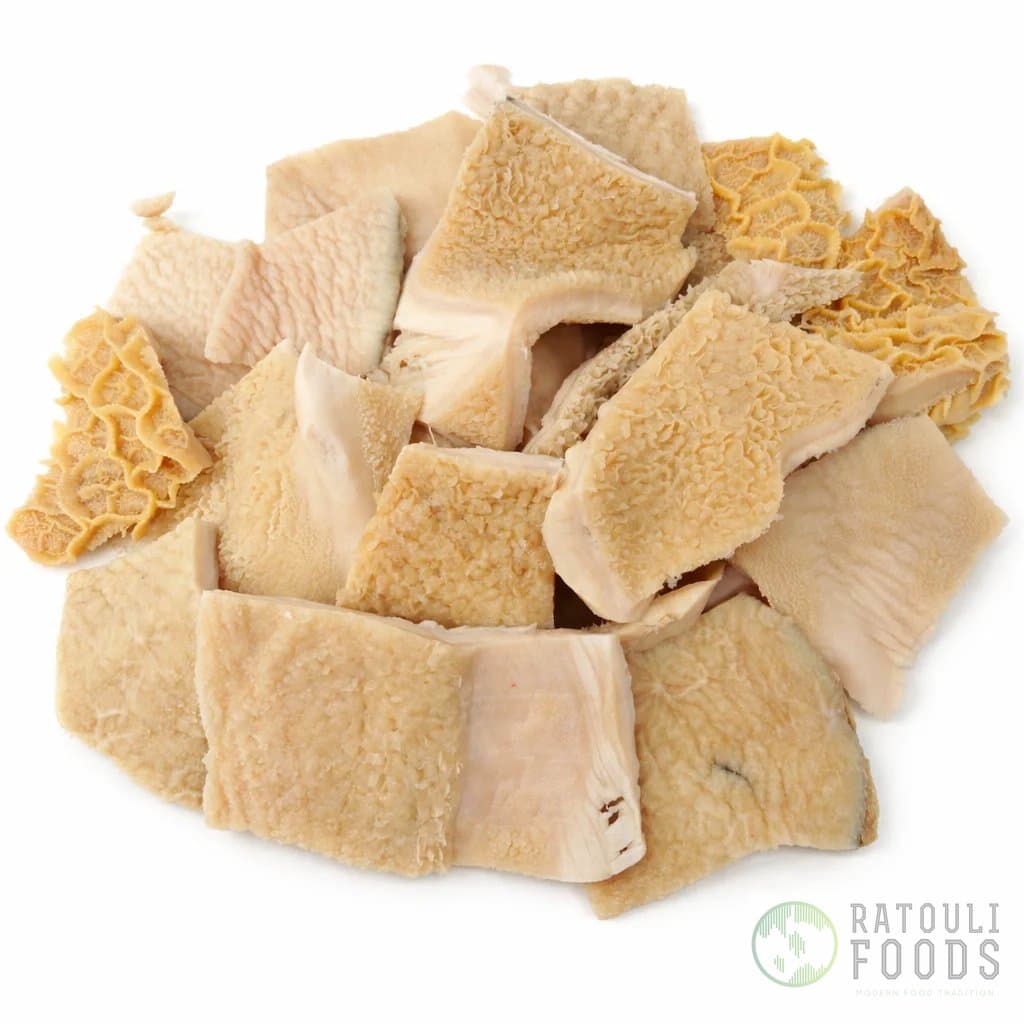
Shaki is beef tripe, the muscular lining of a cow's stomach. In West-African kitchens the word shaki usually means honeycomb tripe, the chambered cut from the second stomach. It is sold scalded, cleaned and cut, then simmered slowly into pepper soup, egusi, efo riro and assorted-meat stews. Tough raw, tender when you cook it right.
What is shaki?
Shaki is the edible lining of a cow's stomach. English butchers call it beef tripe or cow tripe. A cow has four stomach chambers and each one gives a different kind of tripe. When a Yoruba cook says shaki, they almost always mean the honeycomb tripe from the second chamber, the one with the deep six-sided folds. It is the most prized of the four, and the cut most stores just label shaki meat.
Raw shaki is one of the toughest cuts you will ever handle. That is the point. Cook it long and slow and the collagen breaks down into something soft and gelatinous that holds onto pepper and palm oil and never falls apart in an hour-long soup. That is why it carries the heavy stews instead of disappearing into them.
I have traded shaki for 14 years into West-African and Surinamese kitchens across Europe. Below is what a home cook needs to clean and cook it, and what a store or distributor needs to buy it right. One page, no filler.
Sourcing for your store or wholesale?
Request a quote or browse the full catalogue.
Shaki by another name
Tripe is eaten on every continent, so shaki travels under a lot of names. If you are reading a recipe or a packing list and the word shaki is not on it, one of these almost certainly is. The same cut is mogodu in South Africa and the base of menudo in Mexico. Watch for the misspelling saki in search and on invoices.
| Language or culture | Name for tripe |
|---|---|
| Yoruba | Shaki, ṣakí |
| Hausa | Saki |
| Ghanaian (general) | Yemuadie |
| English | Beef tripe, cow tripe, honeycomb tripe, towel tripe |
| Dutch | Pens, runderpens |
| Surinamese | Fladder |
| French | Tripes de boeuf, gras-double |
| German | Kutteln, Pansen |
| Spanish | Callos, mondongo, tripa de res |
| Italian | Trippa |
| Portuguese | Tripas, dobrada |
| South Africa | Mogodu |
| Mexico | Menudo (the dish), tripa de res |
The four kinds of tripe
A cow has four stomach chambers, and butchers split tripe into four cuts to match. This matters more than you would think. A recipe that says shaki wants honeycomb, but a bag labelled tripe in a general supermarket is often the cheaper flat rumen. They cook differently and they look nothing alike on the plate.
| Chamber | Common names | Notes |
|---|---|---|
| Reticulum | Honeycomb tripe | The prized cut. Deep six-sided folds. This is what is usually sold as shaki. |
| Rumen | Blanket, flat, smooth tripe | The largest chamber. Flat and plain, milder, often the cheapest. |
| Omasum | Book, bible, leaf, manifold tripe | Many thin layers like pages. Yoruba onigbaawe. |
| Abomasum | Reed tripe | The true stomach. Sold separately as Abodi, a distinct product. |
One thing to keep straight on a packing list. Abodi is the reed tripe (abomasum) and it is sold as its own item, not as shaki. Two other cuts get confused with shaki at the counter but are different animals entirely. Ponmo is cow skin. Roundabout is the small intestine. Shaki is the stomach lining only.
The Yoruba subtypes of shaki
Walk a Lagos meat market and you will hear shaki broken down further than the four butcher cuts. The Yoruba names describe the part of the stomach and the texture you get. A careful buyer pays attention, because they cook and chew differently.
- Shakoto is the thick, full sac, the meatier and heavier piece. It needs the longest cook and gives the most chew.
- Shaki onigbin is the smooth side, the prized softer cut. Many cooks pick this for a cleaner texture in soup.
- Onigbaawe is the leaf or book tripe, the omasum, with its many thin layers. Same omasum from the four-chamber table above, sold under its Yoruba name.
For most home cooks abroad, you will not get to hand-pick these. What reaches a European freezer aisle is graded and cut for you, usually the honeycomb. But when a customer asks for shakoto by name, now you know what they are after.
The dishes shaki carries
Shaki is rarely the star on its own. Its job is to carry the heavy, long-simmered soups and stews, the dishes where you want a piece of meat that soaks up flavour and stays intact for an hour on the heat. Here is where it lands most often.
- Pepper soup, the hot, clear, spiced broth where shaki is a classic protein.
- Egusi soup, thickened with ground melon seed, one of the most common homes for shaki.
- Efo riro, the Yoruba spinach stew, where shaki joins the assorted meats.
- Okra soup and ogbono draw soup, the drawing soups, where the chew of tripe plays against the slip of the base.
- Ofada and ayamase stew, the green pepper stews served with ofada rice.
- Assorted meat, what Yoruba cooks call orisirisi, a mixed pot of tripe, skin and offal.
- Igbo nkwobi, spiced offal in a thick palm-oil sauce.
- Ghanaian goat light soup, where tripe often joins the goat.
In every one of these the rule is the same. Shaki is the toughest cut in the pot, so it goes in first and cooks longest. More on that below.
How shaki is cleaned, and why scalded-and-cut matters
Raw, uncleaned tripe comes off the animal green or brown. That is unbleached tripe, and it needs real work before it goes near a pot. White tripe is what you usually see in a shop. It has been cleaned and dressed, which means scalded, scraped and rinsed so the gut content and the dark outer membrane are gone.
If you start from a raw or part-cleaned piece, the home method is simple but physical:
- Scrub hard with rock salt and either vinegar or lime juice to cut the smell and grip the surface.
- Scrape inside the honeycomb folds, where residue hides. This is the step people skip and regret.
- Par-boil for 10 to 15 minutes, drain off that first water, then start your real cook in fresh water.
This is why the way I ship shaki matters to a kitchen. It goes out scalded, cleaned and cut, then frozen. The hardest, smelliest, slowest part is already done before it reaches the cook. For a restaurant turning tables or a home cook on a weeknight, that is hours saved and a far more consistent result. Cleaned and cut also means even pieces, so they cook at the same rate. Nothing comes out rubbery while the rest goes soft.
How to cook shaki
One rule above all others. Cook shaki first. It is the toughest thing going into the pot, so it gets a head start, and the other proteins join later so nothing overcooks while the tripe catches up. Skip this and you get tripe like an inner tube while your fish has fallen apart.
A reliable sequence for already-cleaned shaki:
- Par-boil 10 to 15 minutes with onion, salt and a stock cube or your aromatics. Drain that first water.
- Simmer in fresh seasoned stock until tender. From frozen and cleaned, plan on roughly 45 to 90 minutes of gentle simmer depending on the thickness of the cut. Shakoto, the thick sac, sits at the long end.
- Test by chewing a piece. Tender shaki gives easily and is still slightly springy. It should never be tough, and it should never be mush.
- Add it to your soup or stew once tender, with the stock it cooked in, so none of that flavour is wasted.
A pressure cooker cuts the simmer roughly in half, around 20 to 30 minutes under pressure. Low and slow on the stove gives a better texture if you have the time. Either way the order does not change. Shaki goes in first.
Nutrition snapshot
Tripe is lean, cheap protein with an unusually good micronutrient profile. The numbers below are for cooked beef tripe, roughly per 100 grams.
| Per ~100g cooked beef tripe | Amount |
|---|---|
| Calories | ~85 to 95 kcal |
| Protein | ~18 to 20 g (about 35% collagen) |
| Vitamin B12 | Over 100% of daily value |
| Selenium | ~17 to 33% of daily value |
| Zinc | Present, meaningful |
| Fat | Lower than most beef cuts |
| Cholesterol | ~178 mg per 5 oz serving |
The protein is complete, and a good share of it is collagen, which is what gives long-cooked shaki that soft, gelatinous bite. For the calories you get a lot of protein and a serious hit of B12 and selenium. The one number to watch is cholesterol, higher than lean muscle beef. So it is offal you enjoy regularly rather than a daily staple.
How to store shaki
Shaki is offal, so it does not forgive being left warm. The simple version for a home kitchen:
- Frozen, keep it at -18°C and use it within months, not days. It ships frozen for a reason.
- Thaw in the fridge, overnight, not on the counter. A cold, slow thaw keeps the texture and is safer.
- Cooked shaki keeps three to four days in the fridge. It also freezes well already cooked, which is handy if you batch a big pot of soup.
- Do not refreeze raw shaki once it has fully thawed. Cook it, then freeze the cooked portion if you need to.
Because the shaki I supply arrives cleaned, cut and frozen at -18°C, the cold chain is the only thing a buyer has to protect. Keep it frozen until you are ready to cook and you have done your part.
Wholesale and sourcing for stores and distributors
If you run an African or Caribbean grocery, a restaurant, or you distribute frozen meat across Europe, here is how shaki works as a trade item. I am Ratouli Foods, a B2B West-African and Surinamese food wholesaler in Volendam, Netherlands, 14 years in. We supply shaki scalded, cleaned and cut, then frozen.
Pack sizes:
- 12 x 1 kg cases.
- 24 x 500 gram cases.
Both go out frozen at -18°C, delivered DAP, so the cold-chain transport is handled to your door. We deliver across the Netherlands, Belgium, Germany, France, Spain, Italy and the UK. We run under EU approval number NL208262EG, work to HACCP, and have a public NVWA inspection record, which matters when you are reselling offal and your own customers ask where it came from.
A note on demand if you are planning stock. Shaki moves hardest around the New Yam Festival in August, around Eid, and through December. The biggest diaspora buyers are Nigerian and Ghanaian communities. The UK alone has roughly 270,000 Nigerian-born residents, plus Surinamese and Caribbean buyers in the Netherlands and growing Ghanaian and Nigerian communities in Germany, France, Italy, Spain and Belgium. Order ahead of those peaks, not into them. Tripe is one of the items that sells out first.
Sourcing for your store or wholesale?
Request a quote or browse the full catalogue.