
Surinaamse worsten for tokos and snackbars: kip, rund, bloedworst and fladder per kilo or box
Run a toko, snackbar or kitchen and need Surinaamse worsten by the kilo or by the box? Here is the short answer. Ratouli Foods supplies vleesworst, kippenworst, bloedworst and fladder in 500g and 1kg retail packs and in 10kg per doos bulk cartons, los or vacuum, branded or unbranded, delivered DAP across the EU and UK at -18 C.
What you are actually buying: the four worsten and one offal cut
Before pack sizes, know the products. Surinaamse worst is not one recipe. We carry four distinct lines on the wholesale list, and your shelf or kitchen probably wants a mix of them.
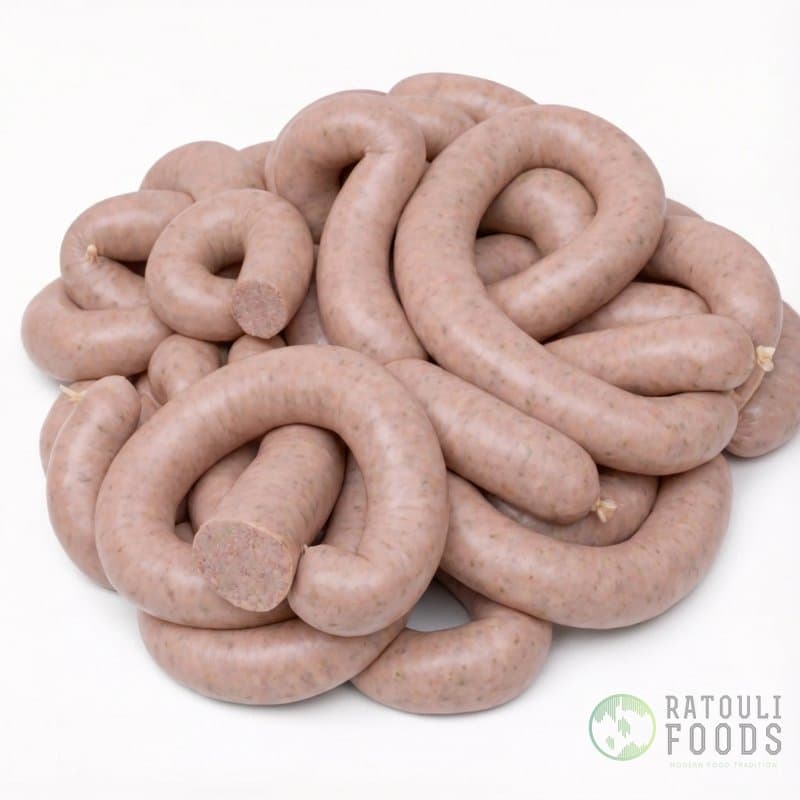
Vleesworst is the coarse, heavily peppered Surinamese meat sausage. No single meat sits behind the name. The classic version, the one you know from the stalls in the Bijlmer, is all beef in a beef casing, and the guest squeezes the filling out rather than eating the skin. The home and toko version is just as common. That one is pork or a half-om-half blend with speklap, bound with egg and milk-soaked bread, seasoned with fresh pepper, garlic, onion, celery, beef bouillon and ajinomoto, stuffed into varkensdarmen and steamed around 45 minutes. You eat it hot, sliced, warmed in spiced bouillon, in a broodje or on its own, always met peper en zuur.
Kippenworst, also written kipworst, is the 100% kip line. No pork, no rund, no lam. It is the no-pork counterpart to the classic, made for Hindostani and Muslim buyers and for any shelf that needs a sausage without pork on the label. It is made with 100% halal ingredients, 100% kip, no varken, no rund.
Bloedworst is Surinamese blood sausage. The traditional version is pork blood with breadcrumbs, onion, sea salt, black pepper, ginger, sugar and marjoram in a pork casing, boiled. It runs coarser and less sweet than a French boudin noir. Beef-blood and chicken-blood versions exist for buyers who avoid pork. Bloedworst carries a real Afro-Surinamese history, food the enslaved made from what they were given, so we sell it as the delicacy it is, never as a novelty.
Fladder is a Creole beef-offal delicacy. The authoritative sources, KRO-NCRV among them, point to the lebmaag, the cow's true stomach, though general sources loosely call it pens or runderpens. You soak it overnight, slice it into strips and simmer it slowly in a soup-vegetable bouillon with Madame Jeanette, then serve it alongside hot worsten. We sell it under the Surinaamse Worsten brand in gekookt and ongekookt form. The ongekookt is the raw cleaned offal you simmer yourself. It is beef tripe, so call it that on your shelf, not a generic beef cut.
Sourcing for your store or wholesale?
Request a quote or browse the full catalogue.
Pack formats: 10kg per doos, los versus vacuum, and the retail subpacks
The pack vocabulary is the same vocabulary your customers search with, so we keep it plain. Here is how the range comes packed.
| Format | Pack | Best for |
|---|---|---|
| Retail subpack | 500g | Toko and ethnic supermarket shelf, single-household sell-through |
| Retail subpack | 1kg | Family buyers, avondwinkel, broodjeszaak prep |
| Bulk carton, los | 10kg per doos | Snackbars, caterers and kitchens that portion in-house |
| Bulk carton, vacuum | 10kg per doos in vacuum packs | Longer shelf life, sub-wholesale, mixed resale |
Los versus vacuum is the call most buyers weigh. Los cartons give you loose pieces you grab and warm straight away, which suits a stall or snackbar turning stock the same week. Vacuum holds longer in the freezer and travels better through a resale chain, which is what sub-wholesalers and tokos with slower-moving lines tend to want. We can run the same product either way.
The 500g and 1kg retail packs and the 10kg per doos cartons ship branded with our label or unbranded, your call. Selling under your own house name? Take it unbranded. Want the Surinaamse Worsten or Ratouli mark on the shelf to lean on the recognition? Take it branded. Same sausage inside.
The kip line: 100% kip, made with 100% halal ingredients
The kip line exists for a real reason. The famous warm-worst stall at Amsterdamse Poort, in front of Slagerij Nico, makes its worsten from beef on purpose, so Hindostani and Muslim customers can eat them. That is the everyday precedent for no-pork Surinamese worst, and it is why the kip line moves in the same neighbourhoods.
Here is what goes on the pack, because it protects your shelf as much as mine. Our kippenworst is 100% kip, with no varken, no rund and no lam. It is made with 100% halal ingredients. That is verifiable, and it is what we put on the pack. The allergens to declare are selderij, soja and gluten depending on the recipe, and we give you the exact line for the batch you order.
So we sell the kip line as 100% kip, geen varken, geen rund, made with 100% halal ingredients. That is the plain claim, and it is the one we stand behind for every batch.
Cold chain, approval and delivery: how it reaches your freezer
A frozen specialty line is only as good as the chain that carries it. Ours stays unbroken at -18 C from our floor to your delivery, which is what keeps the texture of a steamed vleesworst and a simmered fladder intact.
- EU-approval number NL208262EG on the production.
- HACCP-compliant process, with the batch documentation you need for your own food-safety file.
- Cold chain held at -18 C, no thaw-and-refreeze in transit.
- DAP delivery across the EU and UK, so the landed price is clear before you order and the freight is handled.
- Allergen and ingredient line supplied per product, per batch.
This matters most to the buyers carrying the risk down the line: tokos, ethnic supermarkets, avondwinkels, broodjeszaken, snackbars, restaurants, caterers and sub-wholesalers. Resell, and you can hand your own customer the same paperwork. We keep one canonical wholesale page on ratoulifoods.com so the spec, the pack list and the approval number live in one place rather than scattered across messages.
Where these sell, and why the demand is steady
The Surinamese community in the Netherlands is around 365,000 people, the largest Caribbean community in Europe, concentrated in Amsterdam Zuidoost, Rotterdam around the West-Kruiskade, Den Haag around the Hobbemaplein and Almere. Vleesworst, bloedworst and fladder sit in the Afro-Surinamese and Creole strand of that community, and the kip reformulation widens the reach to Hindostani and Muslim buyers in the same streets.
The calendar gives the demand its peaks. Keti Koti on 1 July, the day that marks the abolition of slavery, is built around shared meals, and the worsten are part of that table. Kwaku Summer Festival in Amsterdam Zuidoost runs four weekends across July and August at Nelson Mandela Park and draws somewhere between 150,000 and 300,000 visitors, with the 2026 edition from 11 July to 2 August. The stands there sell exactly this range alongside bara, pom, roti and moksi alesi. Supply a stall, a snackbar or a caterer working those weeks, and you want stock landed before the rush, not during it.
For a toko buyer searching surinaamse worst groothandel or a kitchen looking for a toko leverancier worst, the practical point is the same. Recipe demand is evergreen. Festival demand is sharp and predictable. And no single brand owns national frozen delivery yet. We built the kip, rund, bloedworst and fladder range, the 10kg per doos and retail packs, and the DAP cold chain to fill exactly that gap. Tell us the mix and the volume and we will quote it.
Sourcing for your store or wholesale?
Request a quote or browse the full catalogue.
Looking for the crispy 100% chicken version? See our sister brand Crispy Vleesworst.