
African Grocery Store Supplier: A Full Stock List for Shaki, Abodi, Ponmo, Cow Feet, Cow Ears and Salted Fish Across the EU and UK
If you run an African or Surinamese shop in Europe, you can stock most of your frozen protein range from one EU-approved supplier instead of three. Ratouli Foods in Volendam (EU number NL208262EG, HACCP) makes and ships frozen beef offal (shaki, abodi, ponmo, cow feet, cow ears), salted and dried fish (Bakkeljauw, makayabu, stockfish, saithe, pollock) and the Surinaamse worst family, in packs from 1kg up to full pallets, delivered DAP to your shop door in NL, BE, DE, FR, ES, IT, PT and the UK. This page is the stock list and how to order off it.
One EU-approved supplier for your store's frozen offal and salted fish
Most African and Surinamese shops in Europe buy the same protein range from three or four different places. The frozen offal comes from one wholesaler. The salt fish from another. The Surinaamse worst from a cash & carry across town. Every step adds a margin you end up paying, and every step is a separate phone call the week something runs out.
We have been at this 14 years. Ratouli Foods is an EU-approved food business in Volendam, the Netherlands, EU number NL208262EG, run to HACCP. From one cold store we make and pack the frozen beef offal, the salted and dried fish, and the Surinaamse worst that African, Caribbean and Surinamese shops sell every week. We deliver it DAP (Delivered At Place) to your shop door across seven markets.
The name on the shop differs by market. Yours might be an Afro-Shop (DE), an epicerie africaine (FR/BE), a negozio africano (IT), a loja africana (PT), a tienda africana (ES), a Surinaamse toko (NL) or an African Caribbean grocery (UK). The sourcing problem underneath is identical everywhere. You need a clean range of frozen protein, in the right pack sizes, from a supplier who can prove what is on the pack. That is what this list gives you.
Read this page as the assortment map. Each product group below links into the deeper guide for that product, so you get the stocking detail without us repeating it here.
Sourcing for your store or wholesale?
Request a quote or browse the full catalogue.
The core stock list by product group
Here is the range in one table. The product, the names your customers ask for at the counter, and the pack sizes we ship to stores. The trade names stay exactly as written (shaki, abodi, ponmo, Bakkeljauw, makayabu), because that is how your customers search online and how they ask across the counter.
| Product | Local names customers use | Pack sizes to stores |
|---|---|---|
| Beef tripe (shaki) | shaki, saki, towel tripe, beef tripe | 1kg consumer, 5kg, 10kg carton |
| Beef reed (abodi) | abodi, cow reed, large intestine, roundabout | 1kg consumer, 5kg, 10kg carton |
| Cow skin (ponmo) | ponmo, kpomo, pomo, wele, canda, kplo, cow skin | 1kg consumer, 5kg, 10kg carton |
| Cow feet (bokoto) | bokoto, cow foot, cow leg, koeienpoten | 1kg consumer, 5kg, 10kg carton |
| Cow ears | cow ears, beef ears, pepper soup cut | 1kg x10, 2kg x5, 5kg, 10kg |
| Salted fish | Bakkeljauw, batjauw, makayabu, poisson sale, salted saithe/pollock | 400/500/600g consumer, 5kg, 9 to 10kg carton |
| Stockfish (dried) | stockfish, stokvis | by grade, carton |
| Surinaamse worst | vleesworst, bloedworst, kippenworst, fladder | consumer pack, 5kg, 10kg |
Two things hold across the whole list. It is all frozen and moves on the cold chain, so any shop with a chest freezer can carry it. And the pack ladder runs from a single 1kg consumer unit up to cartons and full pallets, so a one-freezer shop and a busy one buy from the same range, only in different quantities. More on the ladder further down.
Beef offal: shaki, abodi, ponmo, cow feet, cow ears
Frozen beef offal is the steady mover in West-African and Surinamese shops. The names shift from one community to the next, the cuts come off the same animal, and the demand holds week after week. Here is the offal range, and what each one actually is.
Shaki (beef tripe)
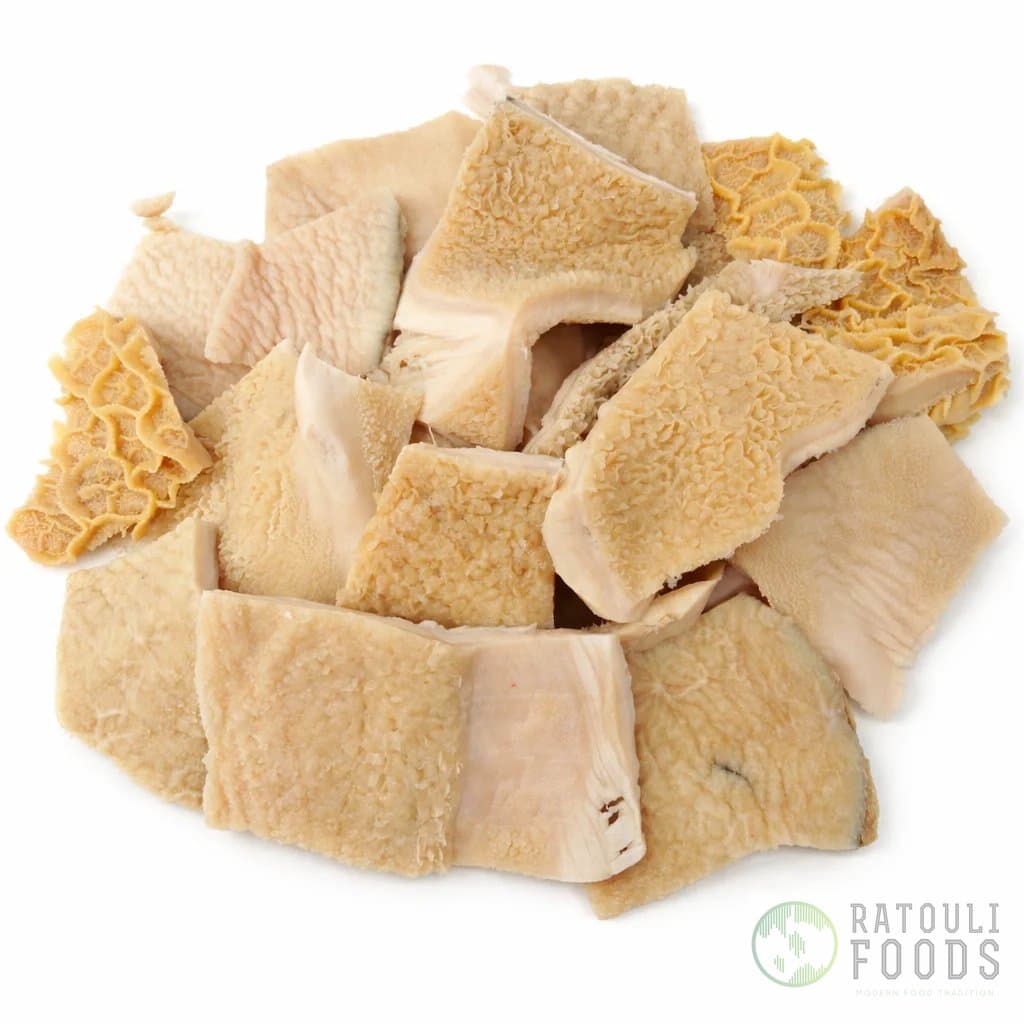
Tripe, the stomach lining, sold as shaki or saki, sometimes labelled towel tripe. It drives shaki pepper soup, nkwobi mixes and Surinaamse stews. Our shaki complete guide and shaki wholesale stocking guides go into cleaning, yield and shelf life.
Abodi (beef reed)
Beef reed, also called cow reed or large intestine, and known in some Yoruba dishes as part of the roundabout mix. Stores sell it as "beef reed / abodi". It carries nkwobi and isi ewu cooks. The abodi complete guide has the cleaning and cooking detail.
Ponmo (cow skin)
Cow skin, the single richest name set on this list. One product, called ponmo (Yoruba), kpomo or pomo (general Nigerian), wele (Ghanaian Akan/Twi), canda (Cameroon/Sierra Leone), kplo (Ivorian/Congolese French), and plain cow skin in English. We pack both the singed brown skin and the scalded white skin. The ponmo names-across-cultures guide maps the full set.
Cow feet (bokoto)
Cow feet, called bokoto, or cow foot and cow leg in English, koeienpoten in Dutch. It cooks down for nkwobi, bokoto pepper soup, and the Surinaamse and Antillean soups people want for the collagen. We singe it the way those dishes call for. See the cow feet complete guide.
Cow ears
Cow ears, also beef ears, often sold as the "pepper soup cut". This is where the consumer pack meets the trade carton cleanly. We ship it 1kg x10, 2kg x5, 5kg and 10kg, so you put 1kg units on the shelf and hold cartons in the back.
All five are 100% beef. What we publish is the cut, the pack and the cold-chain spec, and we stand behind that.
Salted and dried fish: Bakkeljauw, makayabu, stockfish, saithe, pollock
Salted and dried fish is the strongest cross-market pull on the whole list. It sells in a Surinaamse toko in Amsterdam, a Congolese shop in Brussels, a Nigerian grocery in Peckham and a Cape-Verdean shop near Lisbon. Different names, same fish.
| Name | Community | What it is |
|---|---|---|
| Bakkeljauw (batjauw) | Surinamese / Antillean | salted saithe or pollock |
| makayabu | Congolese / Central-African (BE/FR) | salted saithe or pollock, sold as "poisson sale" |
| stockfish (stokvis) | Nigerian / Ghanaian | air-dried fish, by grade |
| bacalhau-adjacent salt fish | Lusophone-African (PT) | salted white fish |
The trade fish behind Bakkeljauw and makayabu is salted saithe or pollock. Both salt and dry well and hold the texture your customers expect. We pack salted fish in 400/500/600g consumer packs, the sizes a Surinaamse toko sells now, in 5kg, and in 9 to 10kg cartons for the makayabu trade.
The deep salt-fish work (grades, salting, saithe versus pollock, formats like heel, moten, filet and split) sits on our sister site Ratouli Seafood, which carries the salted fish range for African and Caribbean shops. If you want offal and salt fish on one order, you still place it through Ratouli Foods.
Surinaamse worst family for tokos: vleesworst, bloedworst, kippenworst, fladder
For a Surinaamse toko, the worst family takes its own block of the freezer and the hot counter. We make the four that move: vleesworst, bloedworst, kippenworst and fladder. They sell packaged from the freezer and hot off the counter, and they bring people back week after week.
The worst is made with 100% halal ingredients. The kippenworst is 100% kip, geen varken (100% chicken, no pork).
Because we make the worst ourselves under NL208262EG, you buy it direct instead of through the cash & carry. That takes a layer of margin out from between the maker and your shelf. The Surinaamse worsten guide on this site covers the family in full, and the standard toko assortment is in our toko stock list for owners.
What we do not stock (egusi, gari, fufu) and why we focus on protein
We are straight about the edges of the range, because it saves you a wasted enquiry. Ratouli Foods does not make or stock the dry pantry goods. No egusi or ogbono seeds, no gari, no fufu flour, no palm oil, no dried leaves, no plantain. Those bring customers into a shop, but they run on a different supply chain, mostly container-imported dry goods, and we will not pretend to cover them.
We stick to frozen protein and salted fish because that is what we make under our own EU approval, and what we can stand behind on traceability and cold chain. A shop owner who wants the dry-goods range buys that from a general ethnic-food wholesaler. The frozen offal, the salt fish and the Surinaamse worst, the part where EU approval, HACCP and an unbroken cold chain actually reach your customer, you buy from us.
So treat this list as your frozen-protein supplier, sat alongside your existing dry-goods source. One clean relationship for the part of the assortment that carries the most food-safety weight.
Pack ladder: 1kg consumer up to frozen cartons and pallets
The most useful thing for a shop owner is knowing the pack sizes before you call. Here is how the ladder runs across the range, from a single consumer unit up to a pallet.
| Tier | Typical pack | Who it suits |
|---|---|---|
| Consumer unit | 1kg offal; 400/500/600g salt fish | shelf-ready, the unit your customer buys |
| Case | 1kg x10, 2kg x5, 5kg cartons | a small shop restocking weekly |
| Carton | 10kg offal cartons; 9 to 10kg makayabu cartons | a busy shop or a small caterer |
| Pallet | mixed or single-product pallet | a high-volume shop, a buying group, a wholesaler |
You do not need to order a full container. Container suppliers set their minimum around a 40ft reefer, roughly 25,000 kg, which is far more than one shop turns over. We built our model for the size below that: pallet-level and case-level orders delivered to your door. A new or small shop can start on cases and cartons, then step up to pallets once the freezer turns faster.
If you want your own label on the consumer packs, private label is possible on the worst and selected offal lines at higher volumes. Ask when you open the account and we will give you the run size straight.
Ordering and DAP delivery across NL, BE, DE, FR, ES, IT, PT and the UK
We deliver DAP, Delivered At Place. That means the price you agree includes getting the goods to your shop door. You are not booking freight or chasing a carrier. From Volendam we supply shops, caterers and wholesalers in the Netherlands, Belgium, Germany, France, Spain, Italy, Portugal and the United Kingdom.
| Market | Store term | Delivery |
|---|---|---|
| Netherlands | Surinaamse toko, Afrikaanse winkel | DAP to the door |
| Belgium | epicerie africaine, magasin africain | DAP to the door |
| Germany | Afro-Shop | DAP to the door |
| France | epicerie africaine | DAP to the door |
| Spain | tienda africana | DAP to the door |
| Italy | negozio africano | DAP to the door |
| Portugal | loja africana | DAP to the door |
| United Kingdom | African Caribbean shop | DAP, no customs work for you |
For the UK after Brexit, DAP still lands at your door. We handle the export and the customs side, you receive the goods. If you want the full detail on how a UK shop buys from an EU-approved supplier without border friction, we cover it in a dedicated guide.
To open a wholesale account, send us your shop name, address, the markets you serve and a first product list off this page. Tell us your freezer space and how often you want to restock. We come back with pack sizes, lead time and a DAP price to your door. If you want to test before you commit to a pallet, ask about a small first order. The full sourcing walk-through is in our guide on how to source frozen offal and salted fish for your shop.
Sourcing for your store or wholesale?
Request a quote or browse the full catalogue.