
How to Source Frozen Offal and Salted Fish for Your African or Surinamese Store in the EU
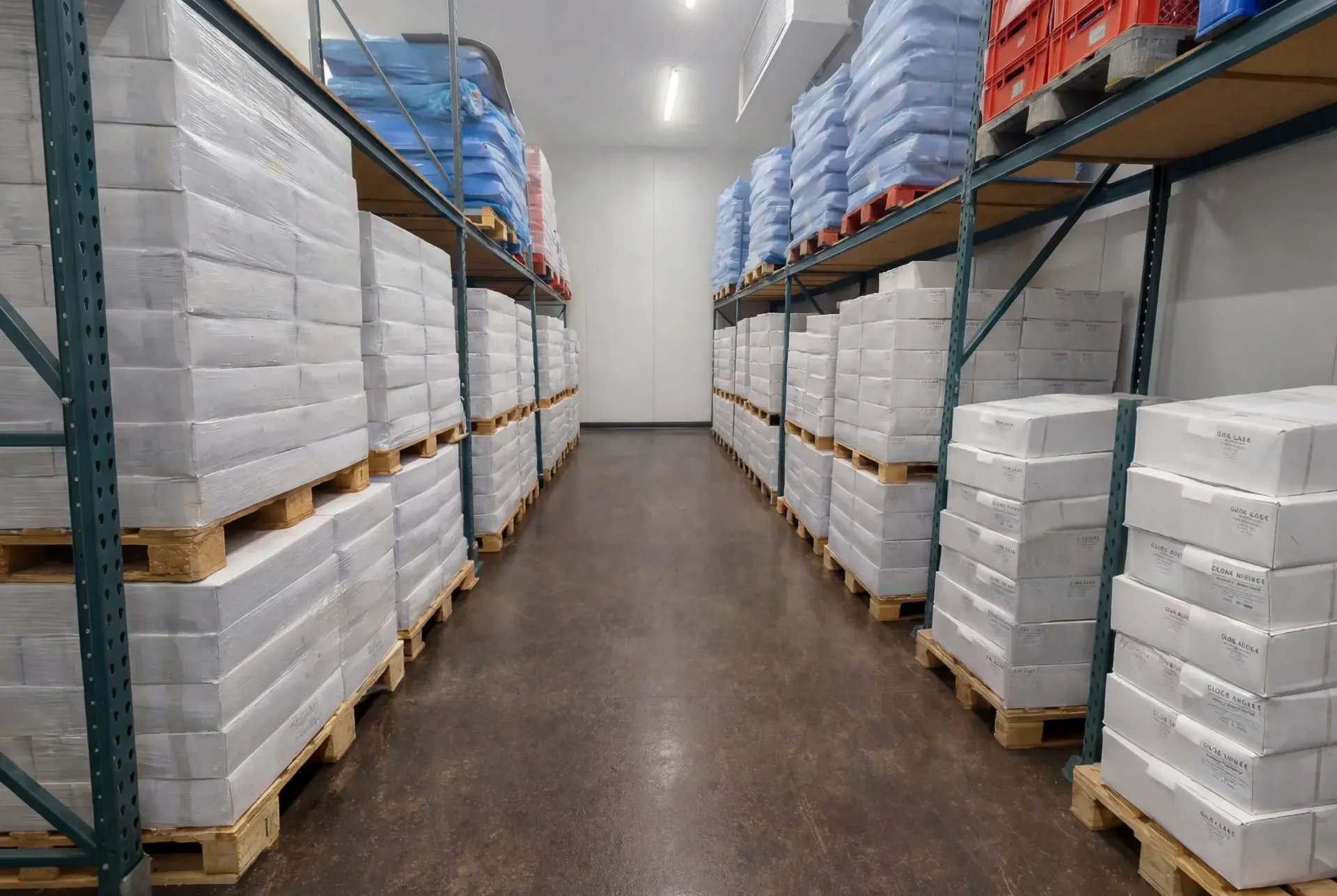
You can stock your shop with frozen beef offal and salted fish from one EU-approved supplier that delivers to your door (DAP) across the EU and the UK. Ratouli Foods is approved under EU number NL208262EG and runs on HACCP. We make and ship Shaki, Abodi, Ponmo, cow feet, cow ears, salted saithe and pollock, plus the Surinaamse worst family. The minimum is one mixed pallet, and most orders land in 2 to 5 working days.
How a single EU-approved supplier with DAP delivery works
Most African and Surinamese shops in Europe buy the same way. You drive to a cash & carry, load the van, and pay whatever the middle layer has added on. It works. It also eats your morning and your margin. The other route is to buy direct from one EU-approved maker who brings the goods to you.
That is what we do. Ratouli Foods is a food processor in Volendam, the Netherlands, 14 years in this trade. We hold EU approval number NL208262EG and run a HACCP food-safety system. We make frozen beef offal and salted fish, freeze it, and ship it to your shop or restaurant under DAP terms, Delivered At Place. You order, we deliver, you fill the freezer. No drive to a cash & carry, no extra reseller between us and your shelf.
Buying direct does two things for you. It cuts the tussenhandel, the resellers stacked between the maker and your counter, so the number on your invoice sits closer to the price at source. And you get one supplier with a traceable number on the carton, instead of a different pallet from a different broker every week. For a 125 to 150 m2 shop balancing fast movers against the niche frozen lines, one clean repeat order beats five scattered ones.
Sourcing for your store or wholesale?
Request a quote or browse the full catalogue.
The three supply models: cash & carry, container import, direct DAP delivery
There are three realistic ways to fill your freezer, and each suits a different size of shop. The table below lines them up on the things that actually decide it. How the goods reach you, the minimum you commit to, what it costs you in time and cash, and who holds the food-safety paperwork.
| Model | How you get it | Minimum | Your time and cash | Best for |
|---|---|---|---|---|
| Cash & carry pickup | You drive to the wholesaler (for example Vanka-Kawat in Amsterdam and Den Haag, or SAFE BV in Rotterdam) and load your own van | None, buy a single carton | Half a day per trip, fuel, and the reseller margin baked into the shelf price | Very small shops, top-ups, testing a new line |
| Container import | You import a full 40ft reefer straight from origin | About 25,000 kg, a full container | Lowest price per kilo, but your cash is tied up, you need cold storage, and customs and HACCP fall on you | Wholesalers and large multi-store operators only |
| Direct DAP delivery (Ratouli) | You order, we deliver to your door across the EU and UK | One mixed pallet | No travel, fixed delivery, we carry the EU approval and HACCP, you pay close to source | Single shops, restaurants and caterers who want one supplier they can rely on |
The gap is in the middle. A single shop cannot move a 25,000 kg container, but it also gets tired of paying the cash & carry markup forever. Direct DAP at a one-pallet minimum lands right in that gap. You get container-style direct pricing without container-style volume.
What EU approval NL208262EG and HACCP mean for your shop
When you size up a frozen-meat or fish supplier, two things tell you the food was made under control. The EU approval number and HACCP. Both are food-safety matters, and both protect you, not only us.
EU approval number NL208262EG. Any establishment that handles products of animal origin in the EU has to be approved and registered by the national authority. In our case that is the Dutch NVWA. The approval comes with a unique number and the oval EU health mark you see stamped on the packaging. NL208262EG is ours. It means an official inspector signed off the premises and the process, and that the goods move freely inside the EU single market. A supplier who cannot hand you an approval number is a supplier whose food you cannot check.
HACCP. Hazard Analysis and Critical Control Points is the system that runs the floor. Temperature control, cold-chain monitoring, batch traceability, and documented checks at every point where something could go wrong. It is the standard your own environmental health officer will expect you to point to up the chain.
In plain terms for your shop: if a customer or an inspector asks where the frozen offal came from, you can name an EU-approved establishment with a traceable number on the carton, not an unbranded box from a broker nobody can identify. One you can stand behind, one you cannot. That is the whole difference.
Minimum order, pack sizes and lead times
The minimum order is one mixed pallet. You do not have to fill it with a single product. Mix Shaki, Ponmo, cow feet and salted fish on the same pallet to match what moves in your shop. That keeps you well under the container threshold while you still buy direct.
Pack sizes step up in a ladder, so the same product fits a consumer shelf, a busy counter, and a restaurant kitchen:
| Pack | Typical use |
|---|---|
| 1kg consumer pack | Retail shelf, the size a home cook picks up |
| 5kg carton | Busy counters, smaller restaurants, fast-moving lines |
| 10kg carton | Restaurants, caterers, high-turnover shops |
| Full pallet | Multi-store buyers and wholesalers, cartons mixed across products |
For context, branded frozen production minimums in this trade usually sit at 1,000 to 3,000 units, and private label at 10,000 to 15,000 units. That is why most shops cannot order straight from a factory. Our one-pallet minimum is built around the single shop, not the multinational.
Lead times. Standard frozen stock ships and lands in 2 to 5 working days to most EU addresses, a little longer for the UK because of the border step, which we handle (see below). First orders take a touch more while we set up your account and confirm delivery details. After that it settles into a short repeat cycle. Everything ships frozen and stays in the cold chain right to your door.
DAP delivery to your door: NL, BE, DE, FR, ES, IT, PT and the UK
We deliver DAP across seven EU markets and into the UK. The Netherlands, Belgium, Germany, France, Spain, Italy, Portugal and the United Kingdom. DAP means Delivered At Place. We arrange and pay the transport, and the goods arrive at the address you give us.
Inside the EU single market there is no customs friction. A pallet from Volendam to a shop in Berlin, Paris, Madrid, Milan, Lisbon, Antwerp or Brussels moves like a domestic delivery, because EU-approved goods circulate freely.
The UK after Brexit. Great Britain now sits outside the single market, so there is a border step on the way in. On DAP terms that is our job to organise, not a reason to walk away from an EU supplier. The goods clear the border as part of the shipment and arrive at your UK door. You take in a pallet, you do not stand in a customs queue. UK lead times run a bit longer than EU ones because of that step, and we tell you the realistic window when you open your account. Shops in the UK, including the Peckham and Tottenham trade, can buy from an EU-approved maker without carrying the border themselves.
Private label and own-brand options
If you sell enough volume to put your own name on the carton, we make private label and own-brand packs. Your label, your branding, our production under NL208262EG and HACCP.
Private label runs at a higher minimum than our standard packs, because the run has to cover dedicated printing and packaging. As a rule of thumb in this trade, private-label frozen starts around 10,000 to 15,000 units per line, against the 1,000 to 3,000 of a branded run. So own-brand suits established shops, chains and distributors building a house range. It is not a first order.
Not at that volume yet? Start with our standard branded packs at the one-pallet minimum, build the lines that sell, and move to private label when the numbers are there. Tell us the products and volumes you have in mind and we give you a straight answer on whether own-brand makes sense for you now.
What we make: salted fish, beef offal and Surinaamse worst
We stick to protein. Frozen beef offal, salted and dried fish, and the Surinaamse worst family. We do not stock egusi, gari, fufu or palm oil. Those are dry goods other wholesalers carry. We make the cold-chain products that are hard to source well and easy to get wrong.
Beef offal. Shaki (tripe), Abodi (beef reed, also sold as cow reed or large intestine), Ponmo (cow skin, the same product known as kpomo, pomo, wele, canda or kplo depending on the community), cow feet (bokoto) and cow ears. These move across every African market in Europe under their local names. Cow skin and cow feet ship singed or scalded and frozen. See our Shaki, Abodi and Ponmo wholesale stocking guides for how each line sells.
Salted and dried fish. The trade fish is salted saithe and pollock, carrying the diaspora names Bakkeljauw (Surinamese and Antillean), Makayabu (Congolese and Central African, sold as poisson sale in BE and FR) and the bacalhau-adjacent salt fish Lusophone shops sell. Our sister brand Ratouli Seafood handles the salted saithe and pollock sourcing in full trader detail, grades and formats included. Same fish, routed to the people who buy it by community name.
Surinaamse worst family. Vleesworst, bloedworst, kippenworst and fladder, the staples a Surinaamse toko keeps in the freezer and hot at the counter. These are made with 100% halal ingredients, and the chicken lines are 100% kip, geen varken (100% chicken, no pork).
How to open a wholesale account
Opening an account is short. The sequence runs like this:
- Tell us what you want to stock. Send the products and rough volumes, plus your delivery country and address. A mixed first pallet is the usual starting point.
- We confirm price, pack sizes and a realistic lead time for your market, EU or UK.
- You place the order. We set up the DAP delivery and the cold chain to your door.
- You restock on a fixed cycle once you see how each line moves. Most shops settle into a simple repeating order inside the first month.
If you are weighing this against your current cash & carry, ask one question. Who carries the food-safety credentials and the transport, and how much reseller margin are you paying for the privilege of doing the driving yourself? Send us your country and product list and we come back with a clear first-order proposal.
Updated June 2026.
Sourcing for your store or wholesale?
Request a quote or browse the full catalogue.