
Spareribs, St. Louis, baby back or krabbetjes: the buyer's cut decoder
A rib order goes wrong more than almost any other pork line, because four different things end up written on the same order line. "Spareribs" on a Dutch quote and "spareribs" on an American spec sheet are not the same plate of meat. A buyer who orders "ribs" with no cut name can get a pallet no kitchen on that order wanted. So here is the decoder. Read it once and you will write a clean order line every time.
The four names you have to keep apart
There are two cuts here, two ways of trimming one of them, and the Dutch trade words sitting on top. Keep those straight and the rest is easy.
Full spare rib, untrimmed. The belly-side rib plate. It is the biggest and fattiest rib cut on the pig. At least 11 ribs plus the costal cartilages, and it still has the breastbone, the rib tips and the brisket flap attached. US spec calls this IMPS 416. It is the cut for a long braise. More bone, more fat, more connective tissue that melts down over hours in the pot.
St. Louis cut. Same plate, trimmed square. Sternum, rib tips and brisket flap come off, so you are left with a clean rectangular rack. Spec item IMPS 416A, usually 12 to 15 ribs, roughly 1.1 to 1.4 kg trimmed. This is what a counter wants on the tray and what a smoker wants on the grate. It cooks evenly and it looks right.
Baby back, the loin back. Different cut. These sit up near the spine, not the belly. Shorter, more curved, leaner, 10 to 13 ribs a rack, and priced at the top end. BBQ restaurants buy them. A stew kitchen does not, because the lean meat dries out before the collagen lets go.
Two more spec numbers turn up when a supplier splits the full plate. 416B is the rib tips and brisket bones on their own. 416C is the spare rib with the breastbone off but otherwise full. Worth knowing when someone quotes you a number instead of a name.
Sourcing for your store or wholesale?
Request a quote or browse the full catalogue.
The Dutch trade words, mapped straight
This is where most mix-ups happen on a domestic quote. In the Dutch trade:
- Spareribs are the belly-side ribs. The familiar rack.
- Krabbetjes are the firmer, fattier breastbone-end ribs with the cartilage lumps on them. Different eating, different price. A stew kitchen often prefers them.
- Dikke ribben is the thicker rib.
- Procureur is pork neck. Not a rib at all. It lands on rib quotes by mistake more often than you would think, so if you see it on a line you did not order, that is why.
So "spareribs vs krabbetjes" is not a quality question. It is two real cuts off two parts of the same belly. Write only "ribben" and you leave the supplier to guess which one.
The membrane, and why it goes on the order line
On the bone side of every rack there is a silverskin membrane. It is elastin. It does not break down in cooking and it blocks rub and marinade from reaching the meat. St. Louis racks usually arrive trimmed of it. Full spares often do not. If your customer marinades or dry-rubs, that one line on the order, "membrane off" or "peeled", decides whether the seasoning does anything. Put it on the spec so nobody is peeling 10 kg of ribs by hand at six in the morning.
Counter rack or stew kitchen: decide before you order
Fastest way to land the right cut is to ask what the meat is for.
For a counter rack or a smoker, the St. Louis cut wins. Square, even cook, clean portions, good on a tray. Baby back if your customer wants the leaner premium rack and will pay for it.
For a stew or braise kitchen, which covers most diaspora and Surinamese cooking, you want the fattier full spare rib or the krabbetjes. The fat and connective tissue carry a long pot. Lean baby back in a braise is wasted money, and the meat goes stringy.
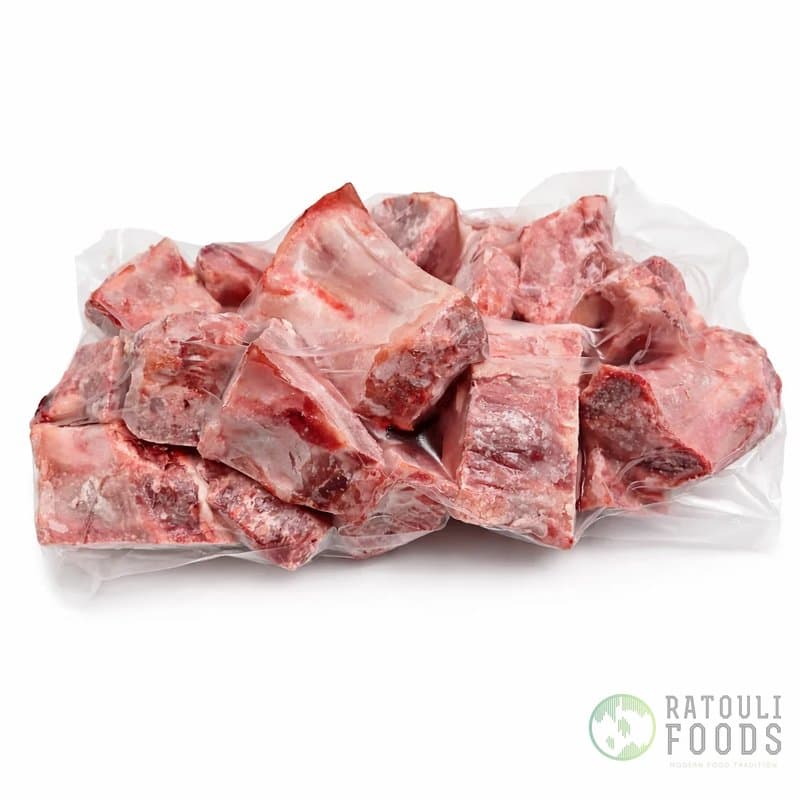
What we ship
We carry spareribs in two lines, both frozen, both 10 kg a box. A standard Spareribs rack, and a Spareribs Small cuts line for kitchens that portion straight into the pot. Both pack variants are on the spareribs page in the catalogue. Delivery is DAP from one pallet across the EU and UK, out of our EU-approved plant (NL208262EG) under HACCP. Not sure which cut your customer is actually asking for? Send us the dish and we will tell you which line fits.
What a complete rib order line looks like
Cut name (full spare, St. Louis, baby back or krabbetjes), membrane on or off, pack size, frozen or chilled, quantity in pallets. Five fields. Get those right and you will not see a wrong-cut pallet come back.
Sourcing for your store or wholesale?
Request a quote or browse the full catalogue.