

Short-cut vs long: how to grade salted pig tails before you buy a pallet
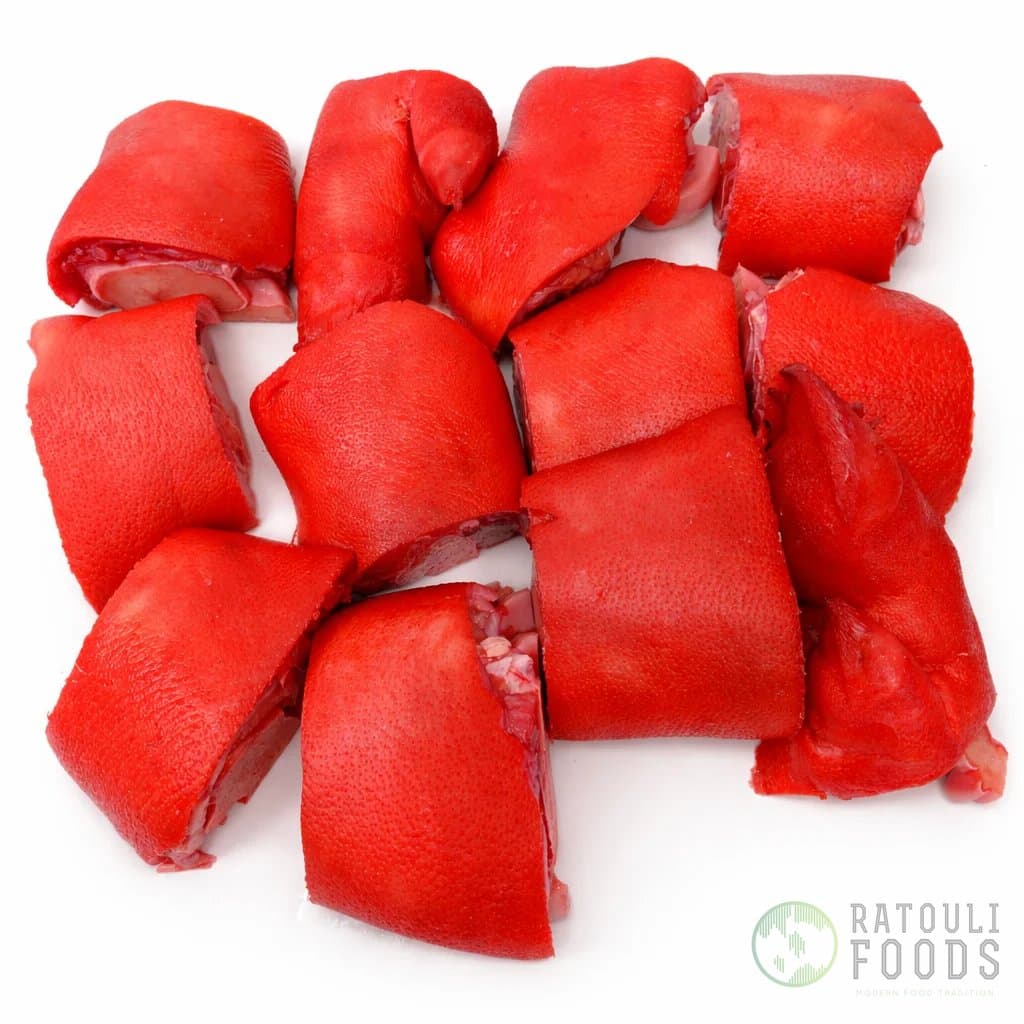
Two suppliers quote you salted pig tails and one is cheaper per kilo. Before you take the saving, look at what you are actually buying. On pig tails the price nearly always comes back to one spec: the cut. A short, thick, meaty tail is a different product from a long, thin one, even when both boxes say the same three words. Ten minutes on this before you commit usually pays for itself.
What a pig tail actually is
The tail is the bony section that runs off the spine. Cut properly, the knife goes a couple of vertebrae into the rump, so you get meat on the tail and not just skin over bone. That extra bit into the body is the whole difference between a tail you can build a pot around and a tail that is mostly handle.
Pig tail is bone-in by definition. That is the point, not a flaw. The bone and the collagen around it are what the Caribbean stew-and-soup trade is paying for. Cook it low and slow, the collagen breaks down, the liquid thickens and the pot gets body. A tail with no meat and little collagen gives you none of that. So grading tails really comes down to how much usable meat and collagen sits on each piece.
Sourcing for your store or wholesale?
Request a quote or browse the full catalogue.
Short-cut and meaty vs long and thin
The trade runs two grades. Short, thick, meaty tails are the premium spec. Long, thin, skinny tails are the cheap one. On a short-cut meaty tail your buyer pays for meat and collagen. On a long thin tail a bigger share of that kilo is bone and skin with not much behind it.
That is usually why the cheaper quote turns out to be the long thin grade. Per kilo it reads like a win. Per portion, after your customer has cooked it down and found mostly bone, it is not. For the stew-and-soup trade the short-cut meaty tail is what moves and what gets reordered. Anchor your comparison on that spec.
Piece count and average weight are the spec, not a guess
Two numbers tell you what is really in the box: piece count and average weight. Get them onto the spec sheet instead of eyeballing a photo.
A working reference: individual tails around 120 g, roughly 15 to 17 tails to a 2 kg pack. Hold any offer against that. If a 2 kg pack carries far fewer pieces at a much higher average weight, you are probably looking at longer tails, and length on a pig tail usually means more bone, not more meat. If the piece count runs high but the average weight is low, the tails are short but light, which can mean they were cut shy of the rump where the meat sits. What you generally want is short-cut and meaty: a healthy piece count with enough weight per tail to show real meat, not just length.
Ask every supplier for piece count per pack and average piece weight in writing. If they cannot give it, that already tells you how the line is graded.
Origin and breed: a real spec line
For pig tails, UK and EU suppliers commonly source from Northern France, Belgium and Poland. One named example is the Pietrain breed from Wallonia. Origin matters because it drives consistency. A buyer who reorders the same line month after month wants the same cut and the same fat-to-meat balance each time, and that holds when the origin and breed stay put instead of shifting box to box.
If a consistent finished dish matters to your own customers, treat origin as a spec line, not a footnote. Ask where the tails come from and whether that source is steady. A supplier who can answer that is a supplier you can build a reorder around.
What to ask before you commit a pallet
Short version, before you sign for a pallet of salted pig tails:
- Short-cut meaty grade or long thin grade. Confirm which one the quote is for.
- Piece count per 2 kg pack and average piece weight, in writing.
- Whether the tails are cut into the rump so there is meat on them.
- Origin and, if it matters to you, breed, and whether that source stays consistent.
Get those four answers and the gap between two quotes usually explains itself. We work from documented specs on our salted pig tails, with piece count and average weight on the sheet, EU approval NL208262EG and HACCP, DAP delivery from about one pallet across the EU and UK. Want to compare a sample box against what you buy now? Ask and we will send the spec. See the full pork catalogue.
Sourcing for your store or wholesale?
Request a quote or browse the full catalogue.