
Mergpijp: cross-cut vs canoe-cut, and which one your channel actually wants
If you write purchase orders for marrow bone, the most common return I see has nothing to do with quality. It is the saw direction. The buyer ordered "mergpijp," the bone arrived sawn the wrong way, and now it will not fit the customer's pot or oven. Mergpijp is the long leg bone, the femur or shank pipe, sawn into pieces with the soft marrow still inside. The English trade term is beef marrow bone. There are two ways to saw it, and they feed two completely different kitchens. Get the direction wrong and the bone is fine on paper but useless to the customer. So this is the short version for buyers: the two cuts, what each does in the pot or the oven, and how to spec it so the right bone lands on your pallet.
Cross-cut: the rings your soup buyers want
Cross-cut means the pipe is sawn across into rounds a few centimetres tall, with the marrow showing as a circle in the middle. In Dutch you will hear horizontaal gezaagd, ring-cut, or pijp-cut. This is the soup and bone-broth format, and diaspora soup buyers order it almost without exception.
The reason is the pot. Over a long simmer the marrow melts out of the standing ring slowly and stays in the broth instead of dropping out all at once. Surinamese, West-African, Antillean and Caribbean kitchens cook marrow bone this way, in soups and stews that run for hours. If your customers are tokos, diaspora retailers, or butchers serving those communities, cross-cut rings are the default. Spec the ring height. Uniform rings of three to four centimetres portion cleanly and look right in the case. Mixed heights look like offcuts and get questioned.
Sourcing for your store or wholesale?
Request a quote or browse the full catalogue.
Length-cut: the canoe for horeca and grill
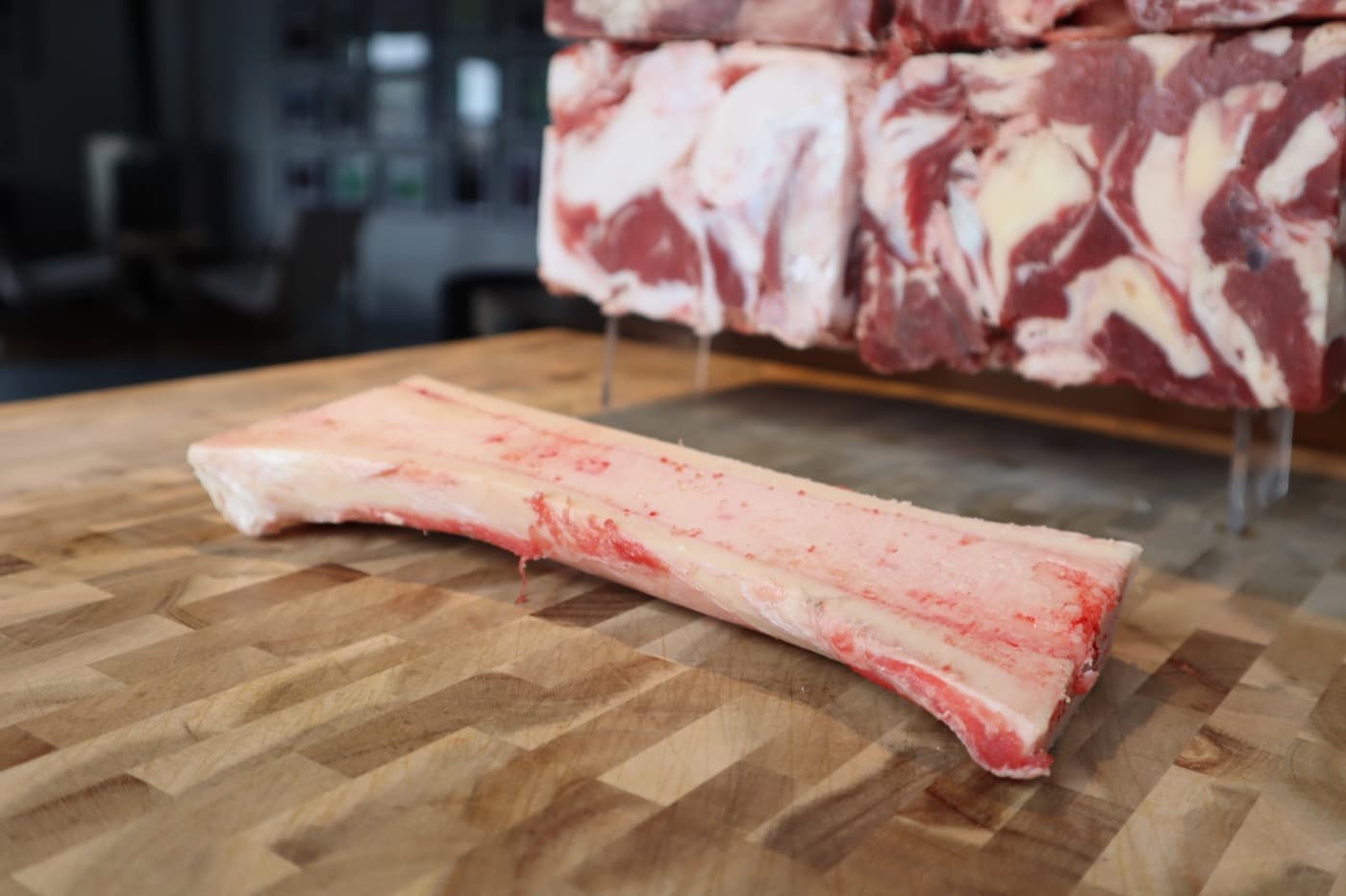
Length-cut, also called verticaal, overlangs, or canoe cut, is the pipe split lengthwise so the marrow trough runs open along the bone. The marrow sits exposed like a boat. That is where the name comes from.
This is the roast-and-scoop format. The cook puts the halves marrow-up in a hot oven, roasts until the marrow goes soft, and serves it for scooping onto toast, or finishes it on the grill. Restaurants buy canoe cut for the plate, not the pot. A buyer sourcing for restaurant menus or a grill program wants this one, and a tray of cross-cut rings will come straight back at you. For canoe cut, spec the piece length and whether the ends are trimmed. Plate presentation hangs on it.
Why the canoe costs more than rough soup bone
One thing to set straight with your own customers: you are paying for the cut, not the bone. A rough soup bone is cheap because it is barely worked. A clean, uniform cross-cut ring or a tidy canoe half is more saw time, more handling, and more give-away in trim and dust. Splitting a pipe lengthwise without splintering takes a steady hand and a good blade. So when a buyer asks why canoe-cut marrow bone prices above a bag of soup bones, the answer is simple: labour and yield loss, not more bone. Same logic holds for neat cross-cut rings against rough-sawn pieces.
Cuts your buyers will compare it to
Marrow bone sits next to a few related items on the order sheet, and it pays to know the difference when a buyer is deciding. Beef shank, the schenkel, is the same region with meat left on, and cross-cut shank is what becomes osso buco. Plain soup bones, soepbotten, are the cheaper rough-sawn option with less marrow on show. Cow foot, koeienpoot, and oxtail, ossenstaart, are different cuts, but they land in the same long-simmer dishes, so buyers often order them on the same line. Knowing where mergpijp fits in that group keeps you from grabbing the wrong thing under pressure.
Quality variables a buyer should ask about
Past cut direction, here is what to confirm before the order goes out. Ring height uniformity on cross-cut. Marrow fill, which runs lower on older or leaner animals, so ask if it matters for the use. Saw cleanliness, meaning no bone dust or splintering on the cut face. Fresh against frozen or IQF, depending on the customer's turnover. And trim level on the ends. We run mergpijp as a beef cut under EU approval NL208262EG with HACCP, fresh or frozen, DAP from roughly one pallet across the EU and UK. You can see how it sits next to our other beef cuts on the beef catalogue, and we cut to a stated spec rather than ship a default.
How to spec it so you never get a wrong-cut return
A complete mergpijp line states three things: cut direction, target piece size, and trim. Mergpijp with no cut direction is an incomplete spec, and an incomplete spec is how returns happen. Write it like this.
- Cross-cut for soup: "Beef marrow bone, cross-cut rings, 3 to 4 cm, ends trimmed, frozen."
- Canoe for horeca: "Beef marrow bone, length-cut canoe, 12 to 15 cm pieces, fresh."
Two extra words on the order line save a pallet coming back.
Sourcing for your store or wholesale?
Request a quote or browse the full catalogue.