
Bakkeljauw: the complete Surinamese guide (what it is, desalting, dishes, history)
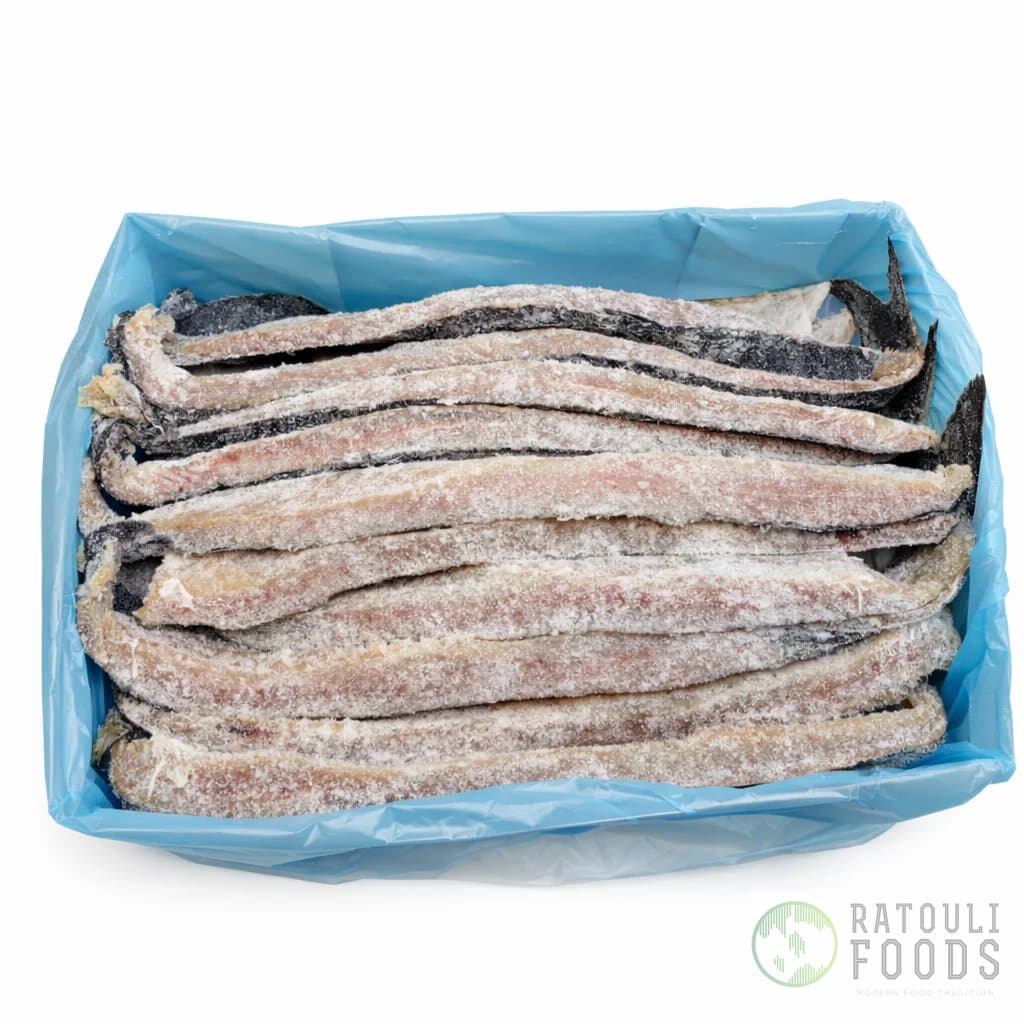
Bakkeljauw is salted, traditionally air-dried white fish. The diaspora kind is usually saithe (Dutch koolvis, Pollachius virens), not the cod most recipe blogs claim. Heavy salt keeps it good for up to a year, which is exactly why it crossed the ocean to Suriname. You desalt it before you eat it.
What bakkeljauw actually is
Bakkeljauw is salted white fish, traditionally dried as well. That is the whole thing in one line. In standard Dutch it is called klipvis, sometimes rotsvis. Bakkeljauw is the Surinamese name for the same product, and depending on whose kitchen you grew up in you will see it spelled bakkeljouw, bakkaljauw, or batjauw.
The word traveled with the trade. It comes from the Portuguese bacalhau, by way of the Spanish bacalao, and it landed in Suriname during the colonial years. The reason it stuck is simple. Heavy salting keeps the fish good for up to a year with no fridge. On a ship crossing the Atlantic for months, that was not a luxury. It was the only way fish made the trip at all. So bakkeljauw became a pantry staple in Paramaribo long before anyone there had refrigeration.
Ask wat is bakkeljauw and a lot of people will answer gezouten kabeljauw, salted cod. That is the common answer, not the right one. The next section explains why.
Sourcing for your store or wholesale?
Request a quote or browse the full catalogue.
Bakkeljauw by another name
One fish, a pile of names, three different things going on. Some names are dialect spellings of the same Surinamese word. Some are just the generic word for salted fish in another language. And some name the actual species that was swimming around before anyone salted it. Mix those three up and you get most of the confusion you find online. Here is the map, kept honest.
| Group | Names |
|---|---|
| Surinamese / Dutch cluster (the salted product) | bakkeljauw, bakkeljouw, bakkaljauw, batjauw, klipvis, rotsvis, bacalao |
| Generic saltfish / salt cod across cultures | bacalhau (PT), bacalao (ES), baccalà (IT), morue salée (FR), Klippfisch (DE), saltfish / salt cod (EN, Caribbean) |
| Names for the saithe itself (the fish) | koolvis (NL), lieu noir / colin (FR), Seelachs / Köhler (DE), carbonero (ES), merluzzo nero (IT), escamudo (PT), coley / coalfish (UK), Atlantic pollock (US) |
One detail worth knowing. In Portugal the word bacalhau is reserved by law for Gadus morhua, real cod. So saithe gets sold there as escamudo, labeled tipo bacalhau, meaning bacalhau-style. The Portuguese drew a legal line that most Dutch recipe writing never bothered with.
The species truth: saithe, not cod
This is the part we care about getting right, because almost nobody else does. The Dutch encyclopedia entry for klipvis opens by saying most of it is cod, then quietly drops the footnote that matters: in Suriname, the Antilles and Central Africa, cheaper species are used instead. The main one is saithe. In Dutch that is koolvis. The species is Pollachius virens. The British call it coley or coalfish, the Americans call it Atlantic pollock. Next to it you will find ling (leng) and tusk (lom).
This is not some niche swap. Since the Grand Banks cod stocks collapsed, saltfish almost anywhere is likely to be pollock, haddock, blue whiting, ling or tusk. Albert Heijn does not hide it. Their product is literally labeled Lufo Bakkeljauw filet Alaska pollock. Yet most recipe blogs still write gezouten kabeljauw out of habit. They are simply wrong about the fish in the bag.
One trap to watch, because the names sit almost on top of each other. Pollachius virens is saithe, also called coley, and that is the bakkeljauw fish. Pollachius pollachius is a separate species, the pollack or lythe. Same genus, different fish. We name the species because a buyer deserves to know what they are actually cooking.
The two forms: filet versus split-and-salted
When you buy bakkeljauw you are really picking between two formats, and that choice decides how much work lands on your cutting board.
- Filet. Sold zonder of met weinig graten, so near-boneless. After desalting it is ready. No shredding, no fishing for bones. It costs more and it is the default on supermarket shelves. This is the easy one.
- Split-and-salted on the bone. This comes as heel (whole) or moten (chunks and portions). It is cheaper, and in return it makes you do the work. You shred it yourself and pick out every bone after desalting. The flavor is excellent and plenty of cooks swear by it, but it is hands-on.
There is also Migas, the small shredded boneless and skinless pieces, the faces, wings, tails and thin loins. It is the economical format, mostly processed in China, and it earns its keep when you want flaked fish for a stew without buying a whole side. In the formal Codex STAN 167 language, a split keeps the whole backbone in, while a fillet removes the fins and the main bones. That one difference, backbone in or out, is what separates a cheap whole bakkeljauw from a tidy filet.
How to desalt bakkeljauw (uitkoken)
Do not skip this. Bakkeljauw straight from the pack is inedibly salty. The Surinamese word for the step is uitkoken, and it is the single most searched bakkeljauw how-to for good reason. Two methods. Pick the one that fits your timing.
- Boil method (fast). Put the fish in plenty of water and boil it roughly 15 to 20 minutes. Drain, taste a small piece, and if it is still too salty, fresh water and boil again. Repeat until it tastes right to you, not to a timer.
- Soak method (slow, gentler). Cover the fish in cold water and leave it about 24 hours, changing the water every 3 to 4 hours. This pulls the salt out without cooking the fish, so the texture stays firmer.
Either way, finish the same. Rinse under cold water, squeeze it dry, flake it apart with your fingers, and pick out every bone you find. With whole or moten you will find a lot of bones, so take your time. Taste before you cook. Salt you leave in now you cannot take out later.
The dishes worth making
Once it is desalted and flaked, bakkeljauw earns its place on the plate. A few Surinamese classics.
- Broodje bakkeljauw. The flagship. Stew the flaked fish with onion, garlic, tomato, a spoon of tomato puree, a Maggi cube and trassi, the shrimp paste that gives it depth. Pile it on a Surinamese witte puntje with zuurgoed pickle and a knock of Madame Jeanette sambal. This is the sandwich people drive across town for.
- Heri heri. Cassava, sweet potato, plantain, egg and bakkeljauw on one plate. A plantation-era dish that became the symbol meal of Keti Koti on July 1, when Free Heri Heri hands out over 10,000 portions across Amsterdam. It carries a lot of history for something so plain.
- Telo. Fried cassava with bakkeljauw, the Surinamese answer to fish and chips. Simple, crunchy, hard to stop eating.
- Moksi alesi and bakkeljauwballetjes. The fish folds into a moksi alesi rice pot, or gets rolled into little fried balls for snacking.
The same flaked fish goes a long way. One bag, a week of different plates.
Storage: keep it chilled
People assume heavily salted fish lives in the cupboard. Bakkeljauw does not. Even at full salt it ships and stores chilled, not at room temperature.
The safety control here is a number called water-phase salt, WPS, the salt concentration in the water that is actually inside the fish. The formula is %salt times 100 divided by (%salt plus %moisture). The rule of thumb is plain: at least 17 percent WPS allows ambient storage, anything below that has to stay cold. Commercial bakkeljauw runs around 51 percent moisture with salt near 20 to 22 percent. Even so, the trade ships and stores it chilled, not ambient. So it stays in the fridge, full stop. When in doubt, chilled. Once you have desalted it, treat it like any fresh cooked fish and eat it within a couple of days.
Bakkeljauw vs makayabu vs stokvis
Three salted-or-dried fish that get jammed together and should not be. Keeping them apart is half of understanding bakkeljauw in the first place.
| Product | What it is |
|---|---|
| Bakkeljauw | Salted (and traditionally dried) saithe or pollock. Klipvis. Must be desalted before eating. |
| Stokvis (stockfish) | Air-dried but unsalted. Stokvis in Dutch, Stockfisch in German, stoccafisso in Italian, okporoko in Igbo, panla in Yoruba. Never a synonym for bakkeljauw, because it has no salt. |
| Makayabu | Salted cod, split with the backbone left in, usually unwashed so it keeps heavy surface salt. A Central African staple, mainly Congolese. We sell it as its own separate SKU. |
One label you will hear in Surinamese-Dutch kitchens is Surinaamse stokvis for bakkeljauw. It is affectionate but technically wrong. Bakkeljauw is salted, which makes it klipvis. Real stokvis carries no salt. The two are not the same fish in a different coat. They are two different ways of preserving fish.
A buying note
When you buy, read the species and the format before the price. A bag labeled Alaska pollock or koolvis is telling you the truth about what is inside, the way ours does. A bag that says only bakkeljauw and leaves the species blank is asking you to assume cod, and the odds are it is not cod.
Then decide how much work you want. Filet if you want to desalt and cook with no deboning. Heel or moten if you want the cheaper price and do not mind shredding and picking bones yourself. Migas if you just want flaked pieces for a stew. None of these is better than the others. They are different jobs. We name all of it plainly, because that is how a trader who actually handles the fish talks to a cook who is going to eat it.
Sourcing for your store or wholesale?
Request a quote or browse the full catalogue.
Sourcing or reselling salted fish? Our sister company Ratouli Seafood handles the trade side.